
 Emma Lennox talks to the festival's film programmer, Belinda Arthur, and discovers that film can have both damaging and therapeutic effects.
It's the launch of the 2nd annual Mental Health Arts and Film festival and the sleek open spaces of Easterhouse performance centre, Platform, is buzzing with a milieu of people of different vocations. Usually when health care meets the arts it is for community based projects on a small scale, but the word 'community' is banned here today as the organisers emphasis the nationwide involvement for a rapidly growing festival. Soft rockers Idlewild have just unpacked their instruments for a two song acoustic set in front of camera crews and photographers and announcements have been made to promote the hundred plus events happening across Scotland between 1-19 October. “Things seem different today, not like yesterday...” croons lead singer, Roddy Woomble, and the lyrics to their 2002 hit You Held the World in Your Arms suddenly metamorphose into the progressive message that the festival is trying to inspire. As care workers and journalists flock towards the musicians for autographs and interviews, I'm in the corner of the café with Belinda Arthur, lead film coordinator, having a in depth discussion about Bambi.
“Bambi's all about dealing with grief,” she tells me in all seriousness, before adding “in a way it should have an 18 certificate because of the stress it causes.”Arthur has an unending enthusiasm for raising awareness of the mental health plight, but at times, and perhaps for her own well being, this is balanced with moments of self conscious, tongue in cheek wit. The point she is making, however, is significant: films have an effect beyond entertainment, and Arthur hopes to address this with a programme of cinema which breaks through psychological boundaries. Arthur's job has been to consider the movies which fit the criteria for exploring and de-stigmatising mental health issues. It was a tough selection process, and to help, Arthur coordinated a panel of film programmers from the Edinburgh Filmhouse and a consultant psychiatrist in London. Sadly everyone's favourite orphan deer didn't make the cut, but Finding Nemo and Madagascar did. “Those films weren't my choice,” she admits ruefully, “but without being too schmaltzy about it they involve fundamental life lessons and values which helps kids to learn and articulate their feelings. The only thing is that Disney kind of over moralises,” she notes with an air of dissent, “Finding Nemo's ok, but I think I would rather have Bambi.”
 Children's films aside, the programme is a diverse mix of feel good faire and hard hitting social drama. There are two musical biographies; Johnny Cash in San Quentin (1969), and Joy Division (2008) both of which portray the lives of the troubled musicians and their influential careers. Ken Loach has a showcase of two films from his distinct back catalogue; the Greenock set Sweet Sixteen (2002) and landmark BBC film Cathy Come Home (1966) which led to the formation of the charity Shelter. Recent releases Lars and the Real Girl (2007) and Little Miss Sunshine (pictured, 2006) bring some quirky silliness to proceedings whilst driving home a message of acceptance. “Unlike any other film festival we've got a real ethical responsibility,” Arthur explains, “and that's what's distinct about us. We're trying to give out a real positive message. Every film we choose goes through a really rigorous process to make sure that we can contextualise for discussions afterwards.”
 It's not just a question of being politically correct, Arthur and her panel have had to look at cinema with heightened awareness of the broad spectrum of individual and political problems caused by health issues. Depression and anxiety are just two forms of mental illness which affects one in four people a year according to a National Statistics report in 2001 and a Samaritans 2002 report reveals that the UK has the highest rate of self harm in Europe at 400 per 10,000 of the population. It's an invisible plight, but it profoundly affects all communities in both personal and social aspects. “Basically I haven't been to the pictures in the last year without thinking, 'is there a mental health angle to this?” says Arthur of her mammoth task of finding films with the right tone and expression. “We've had real, serious arguments over it. But it was interesting because we had a multitude of opinion; some people had the knowledge of dealing with mental health directly, or working in social services, and some came from an academic film background. We'd all fight about what's exploitative and what's not.”
Arthur's biggest motivation, she tells me, is tackling stigma, “a lot of people say that it’s more affecting than the affliction itself,” she states, but aren't Hollywood movies more of a hindrance than a help? “Most films have made things worse,” Arthur is quick to agree, “just about any horror movie has a psycho in it and they've all been labelled as nutters or crazy. Its absolutely horrendous, but the trouble is they're so popular” In recent years trends of 'psychopaths' have taken more exaggerated characterisations, whilst using terminology that is pseudo scientific.
 Among the paranoid schizophrenics and bi polar protagonists is Heath Ledger's Joker in the second highest grossing film of all time, The Dark Knight. Batman couldn't kill an ill man though; instead he tells the Joker he wants to lock him up in a padded cell forever. “Maybe we can share one,” quips the Joker, “They'll be doubling up, the rate this city's inhabitants are losing their minds.” Nobody expects a comic book adventure with super villains and millionaire heroes to be sensitive to real life problems, but the joker's “why so serious?” brand of insanity certainly adds to popular misconceptions. “I don't want to be the person to burst people’s balloons,” says Arthur, perhaps aware of being unpopular, “but we’re on the side of those experiencing something distressing, to try and encourage them to get help. We’re not here to make it easy for people who are prepared to continue to stigmatise.”
 Other films which have incurred Arthur's categorical wrath are films which construe a connection between mental health and crime and she shoots down my own suggestion of the James Stewart classic Harvey (1950), for inferring the magic is real in the denouement. “We’ve avoided the obvious with One Flew Over the Cuckoo’s Nest.” adds Arthur “I’ve got real issues with that film.”
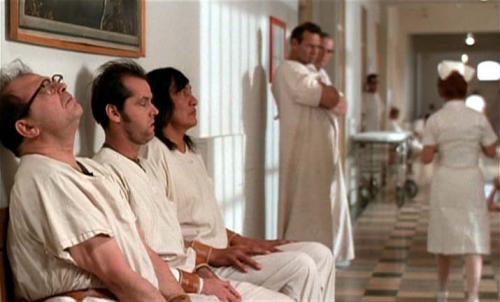 The 1975 Jack Nicholson hit, directed by Milos Foreman depicts exactly the kind of padded cell Batman hopes to incarcerate the Joker in and it's the depictions of the inhabitants which Arthur protests. “If you were sitting in that audience, feeling really at the end of your tether, and you see people portrayed as dribbling and inarticulate or in blank catatonic states, you'd naturally be less inclined to look for help.” What's on screen can foster negative reactions but identity has always been a powerful motivator in cinema for the audience to connect to a story. A positive comparison between the viewer and characters can have a cathartic effect. “It's the same when you listen to music and you think, oh my god that's what I'm going through.” says Arthur, revealing “when I was young and tortured I would listen to the Smiths and think, oh man, someone else knows how I feel! That's what I think you get with watching films, that kind of recognition.”
 For Arthur, the context of the screening makes all the difference and the Mental Health Festival is keen to provide open spaces for discussion. “It's still about what happens after, rather than what the films actually say.” Arthur explains, “it's about the meaning that people take away from it, for them to learn something, or hear people talk about something that they've never talked about. We try and be a forum for them to do that.” Since last year the film section of the festival has increased from six events to thirty with filmmakers and charity organisations on hand to discuss the finer points of the portrayals in post screening talks. There's still scope for expansion and with a topic as endlessly fascinating as the human psyche, Arthur is full of potential ideas. “I would like to do a series of films as 'reel therapy' So maybe next year we do five or six films that are absolutely renowned to make your heart sing. That's for when the festival grows in confidence.”
After all the viewing Arthur has done with other people in mind, I'm keen to find out what film makes this self confessed film buff jump for joy. It turns out to be a black and white classic, notorious for its eye watering, punch in the gut conclusion. “I watched Brief Encounter the other day and even though it's really
 emotional, I just sat there with a huge grin on my face,” she says, her face beaming just at the thought of it “Even at the end, when they separate, it's just beautifully acted, beautifully shot, everything about it's just...” Arthur gesticulates, eager to express her love of the cinematic experience, but is lost for words. In a way she has just summed up the medium which perplexes the senses but can touch the mind in inexplicable and powerful ways.
For more information: http://mentalhealthfestival.dreamhosters.com


 Montiel’s debut novel became a best seller and was quickly optioned for film adaptation. Robert Downey Jnr was set to direct as well as star, but after seeing Montiel’s short film, the Hollywood star urged the author to take the reigns. The short was shown to the producer, Mrs Sting Trudy Styler, and she was so impressed she gave him the go ahead. From the outset, Montiel was determined the film would not be determined by money. “It’s always been the idea of art. Creating, admiring or just to be around it. I consider myself very lucky but to not be around it was not an option.”
 The fiercely personal aspects he was allowed to indulge in literature were however to be reconsidered when it came to adapting the novel for the screen. “It was important that in Saints maintained the spirit of the book but was the story of any kid any where. My stories or films just happen to set been in New York. When I saw City Of God I saw myself in Brazil, in Sweet Sixteen I was in Scotland, in Cinema Paradiso, Italy. The story should be universal. Everything else is interchangeable.” Despite his assertions, Saints the film remains almost documentary like in its evocation of time and place.

 Whatever practice he managed to squeeze in obviously paid off, and the former front man of 10000 Things would now have to become the former leading man of one of the defining bands in British music history. “With Ian Curtis, and the time that Joy Division were playing, there’s only about an hour and a half of footage of them, two television shows and the rest is VHS of fan recorded concerts of poor quality,” Riley observed, “It was just a case of watching them again and again, and dancing around my living room in front of the TV or the mirror, which was quite embarrassing but essential. It didn’t really all come together until I arrived on set and I got the hair cut, put on the clothes, and the band I started learning the songs.” The recreation of the music itself would prove to be a contentious issue on set. “It’s impossible to do anything completely live from so many different camera angles, and we simply weren’t good enough” adds Sam Riley, and as a result of this the band recorded their versions of the tracks so they could mime to their own playback on set. Riley continues, “We tried playing the songs for the audience of extras first and recorded that version and we played that back to ourselves while filming. So some of it is absolutely live, and the rest is our own recorded performance.”
 Posts
Posts

