Showing posts with label Guest Contributors. Show all posts

Tuesday, 5 August 2008

Man On Wire - Review by Marjorie Gallagher


Director: James Marsh

Running Time: 118 mins

Certificate: 12A

Released: 1st August

The following review was originally published in the print edition of Montage at the Edinburgh Internation Film Festival 2008.

Why would a man want to string a wire between two of the tallest buildings in New York City and walk across it? No safety net, no nothing. There is no why, it’s living on the very edge of life according to Philippe Petit, who did just that in 1974 and captured it all in this fascinating documentary Man on Wire. As soon as he read about the construction of the World Trade Centre Petit knew it had been made just for him. There's documentary footage of Petit as he walks between the spires of Notre Dame and across the Sydney Harbour Bridge, whilst onlookers gape in horror on the streets below. But this is nothing compared to his piece de resistance. Using footage, surreal stills and staging reconstructions that play out like a 1950’s heist movie, James Marsh creates a documentary that is endlessly fascinating and entertaining.

Thursday, 31 July 2008

Once Upon A Time In The West End

In recent years the Western has returned from the hinterlands of cinema. In their re-issue of The Good, The Bad and The Ugly, perhaps distribution pioneers Park Circus know why the Horse Opera is ready for another stampeding encore. Andrew McWhirter talks to John Letham, one of founders of the Park Circus, based in Glasgow’s West End.

Italian maestro Sergio Leone’s 1966 final instalment of his Dollars Trilogy, The Good, The Bad and The Ugly, blazes across cinema screens this weekend for the first time in an extended 179 minute cut. UK film industry success story Park Circus, which celebrated its fifth birthday in March, is behind the unveiling of a fully restored and remastered print. Founded by John Letham and Nick Varley, the venture has carried continuous momentum in a temperamental home industry and specialises in distributing classics and back catalogue films for theatrical release. Managing director Letham, perturbed at the lack of treatment towards the screening of classics, admits “We witnessed a niche, because when you show films at a cinema there’s two things you have to do: one is getting rights clearance and secondly is to secure availability. Time and again we witnessed good films not being showcased, either because people didn’t know who the rights holder was or if the rights cleared then there wasn’t always good material to show it.” That niche philosophy also underpins overall quirkiness to the business in being based outside of a bustling Soho, allowing for the added pragmatic bonus of reduced overheads.

At a time of resurgence in the Western, are the company’s plans a capital gain, cinephile-like dedication, or a combination of both in realising the popularity of debate surrounding a Western renaissance? Whilst the services of former Glasgow Film Festival Director Nick Barley come in fruitful with exhibitor relations, Park Circus are also switched on to cinema culture. This year they’ve handled David Lean and Bette Davis prints to celebrate respective centenaries, and hold awareness of other industry activities too. Letham says, “We’ve a lot of passion in what we do and are very focused. The BFI Southbank are hosting a Clint Eastwood Season, with The Good, The Bad and The Ugly as its key anchor, what we call an extended run for a few weeks so that other titles can gravitate around it.”

Boasting one of the most iconic three-way shootouts in film history, this most influential of Leone’s index sees the return of Clint Eastwood’s The Man With No Name hot on the trail of a $200,000 Confederate bounty alongside repulsive gunman Tuco (the enigmatic Eli Wallach) and scheming mercenary Sentenza (the face, Lee Van Cleef), set to a bloody backdrop of the American Civil War. With over the top violence, god-like gunplay and wry wit, this epic is Leone’s vision to deconstruct, with irony, a genre long recognised as a form of nostalgic escapism and to reinvigorate a whiff of staleness with long-lasting popularity. Passing into the parlance of our times are the words from a famous bath scene where Tuco’s mouthy assassin thinks him cornered until the unattractive anti-hero’s steel barrel emerges through the suds, “If you’re gonna shoot, shoot! Don’t talk!”

The black spectacled and bear-like Leone, similar to a young Kubrick, created such a revision of the Western that his trilogy invited subsequent politicised readings into his work, claiming commentaries on the violent atrocities and futility of the Vietnam War – an easier ability afforded to detached Europeans. With close-quarters gun battles, hangings, and prison camps, the relevance of the final piece of his trilogy to current concerns isn’t easy to ignore, nor are criticisms labelled towards a new cycle’s harsh violence in juxtaposition to contemporary ‘dark times’. According to Letham Park Circus’s motivations behind the release are a little more practical, “There’s a lot of reasons why we choose to do what we do, the first being our close relationship to exhibitors. If you’re leasing your James Bond picture, you put your block in the calendar, but if you are releasing a re-issue or smaller release you really have to work that bit harder. It’s crucial to know what they’ll take.” Regardless of allegorical and politicised readings of the Western, he does acknowledge a renewed thirst for the films, “Absolutely, with some of the poster artwork we’ve done we’ve really tried to capture that a little bit, Clint Eastwood with a modern twist”.

Although genre puritans might look for a showdown, narrative film and the Western began hand in hand with The Great Train Robbery in 1903. With the number of Western films dwindling as early as the 1950s, by all accounts the Hollywood favourite should’ve been bundled through the saloon doors and rode peacefully out of town by now. A glance at the oater in the last couple of years (Seraphim Falls, September Dawn, Broken Trail, Bury My Heart At Wounded Knee, 3:10 to Yuma, The Assassination of Jesse James by the Coward Robert Ford and No Country for Old Men) offers fisticuffs in defense. The cult popularity of The Good, The Bad and The Ugly might seem adequate reasoning for its return, but Letham has his own philosophy as to why this genre endures, “When people talk about what makes a classic and what no longer works with contemporary audiences the period pieces like the Western always hold their own. The visuals don’t date like 1970’s or 1980’s movies set in that period and, unlike SF, the western isn’t all about effects. It’s the action, intrigue and the storylines that appeal.” It’s this demand that sees new projects on the horizon on both the large and small screens. The Last Horseman and The Hard Ride are just two of the many TV mini-series planned in the US for 2009, and Ed Harris directs Renee Zellweger and Viggo Mortensen in hired-gun mythical adaptation from Robert B. Parker’s novel Appaloosa later this year. Productions are not confined to horizons west though, as a release of Japanese director Takashi Miike’s postmodern flick Sukiyaki Western: Django is planned in the UK and the spurs continued to be spotted on Harry Potter (Goblet of Fire) director Mike Newell, reported to be working on a project about a native American bounty hunter. Further ahead still, plans to belatedly celebrate The Lone Ranger’s 75th Birthday in epic Disney style are in place. And Park Circus have already extended to making the full Dollars Trilogy (1964’s A Fistful of Dollars, and its 1965 sequel For A Few Dollars More) available to cinemas, “We’ve not reissued them as such, so some cinemas will, over a period, be doing the whole trilogy”.

A quick search of the organisation’s catalogue reveals that only a handful of their 7000 strong titles are Westerns, 12 to be exact. Letham believes he has a good mix between some of the best directors, like Robert Aldrich (Vera Cruz) and the biggest films, like The Big Country, but classification issues arise, “The Western catchphrase is interesting from the point of view of what actually makes a Western. There’s probably more in there, but we don’t have the majority of them. If you look at IMDB for example their top 50 westerns start with Leone’s The Good, The Bad and The Ugly and Once Upon a Time in the West, so if you are going to re-release stuff you’ve got to look at those types of titles, which are always going to be classics of cinema.” Whilst the genre is the longest lasting and largest in cinema history, the undersized presence it has at Park Circus reflects larger ideological concerns as to which Westerns are in fact celebrated. This bias has existed since writing about the genre became vogue in the critic’s circles of 1950s Paris. Scholar-fans have since selected a corpus of films from 1950s to the 1970s and excluded much else – which means 70% of overall production in the 1930s & 1940s heyday rolls along with the tumbleweed. Just as partiality exists at the heart of the selection of a Western canon, it also filters through to preconceived notions of what certain groups of Westerns represent.

From a director who made only seven feature films, Leone’s ‘spaghetti’ oeuvre in the ‘60s and ‘70s will always invite cultural readings into a troubled time for America (corruption, war, assassinations) played out on screen by the mythological iconography of its past. Asking why dystopia, then, is emblazoned across films today like No Country for Old Men appears as futile as asking Russell Crowe’s character, Ben Wade, in 3:10 to Yuma what time that deathly train departs. Films have simply readjusted violence into a new realm of realistic that makes Leone’s films seem tame by comparison. Therefore, Park Circus welcomes a re-examination of the X-rated trilogy, “The violence issues are interesting, and we obviously like to put things back through BBFC and they do respond well by looking at modern audiences, to be fair I think that 15 is the correct rating for it.”

As the years pass, each of today’s Western output may well be grouped under the banner of darker times and prophetic of unspeakable futures, just as Leone’s crop has. But there are never absolutes; just as Leone’s violently artistic Westerns may have been reactionary to other factors (declining cinema audiences of the 1960s or the abolishment of harsh censorship) the reasons behind a current cycle are plentiful: pleasure, prestige, rewriting myths, political, allegorical, etc.

That the genre, if not leading a cattle drive, is grazing famously on public appetite again is not to say it’s ever been away. In American life the mythological presence of the West never strays too far from Route 66 billboards or hero rhetoric to aid partisan politics. The point being, whilst there may be many answers to why Westerns existence thrives again, there’s never a definitive one. Just as old-styled action will entertain in 3:10 to Yuma, films like 2003’s The Alamo will display a knee-jerk reaction to atrocities like 9/11 in its failed attempts to rouse a nation, whilst a movie like September Dawn, recounting a 1857 massacre carried out by Mormons at the behest of the ‘American Moses’ Brigham Young, reminds fanaticism isn’t restricted to one race. The only certainty is that Westerns are doing what they always do, reminding of the good, the bad and the ugly.

The Good, The Bad and The Ugly plays at BFI Southbank, The Filmhouse in Edinburgh and other key cites from Aug 1st.
www.parkcircus.com to find out where.

Friday, 8 June 2007

Craig Milne reviews his ten favourite films, Part 5

Dr. Strangelove or: How I Learned to Stop Worrying and Love the Bomb
UK 1964
Director: Stanley Kubrick
Screenwriters: Stanley Kubrick, Terry Southern, and Peter George
Runtime: 96 min
Certificate: PG
DVD Distributor: Columbia TriStar Home Video

In what is fast becoming a list of comedies, I could not possibly omit what is arguably the greatest comedy of all time. The word ‘timeless’ is an abhorrent cliché, but in the case of Stanley Kubrick’s blacker than black comedy, it genuinely applies. Although the sense of impending nuclear doom is possibly not as palpable now as it was back in 1964, it is still bitingly hilarious forty years on.

Making such a fiendishly funny film out of such a depressing idea is no small achievement. Kubrick’s initial attempts to write a serious screenplay based on the same story (taken from the novel Red Alert by Peter George) were abandoned due to the sheer absurdity of the idea of ‘Mutually Assured Destruction’. With his project now a farcical comedy, Kubrick’s greatest masterstroke was casting the genius Peter Sellers in three roles: Captain Mandrake, President Muffley and Dr. Strangelove (even the names of the characters are all sexual references). Kubrick mixes his vicious satirising of the military with sexual innuendo, from Major ‘King’ Kong of the B52 reading playboy while flying his aircraft, to General Buck Turgidson taking calls from his mistress in the ‘war room’. The subtlety of the script, full of sharp one liners, piercing satire and innuendo, juxtaposed with Sellers’ finely tuned tomfoolery results in a film of unprecedented comic brilliance.


Clerks
USA 1994
Director: Kevin Smith
Screenwriter: Kevin Smith
Runtime: 92 min
Certificate: 15
DVD Distributor: 20th Century Fox Home Entertainment

Oh look, another idiotic comedy. Although I am not a massive fan of his subsequent works, Kevin Smith’s debut, Clerks, is an exceptional film. Made for next to nothing, it made a name for itself on the festival circuit, winning nominations and awards at Cannes and Sundance among many others. The cast, mostly Smith’s friends, cannot act, but the filthy, quick-fire dialogue moves proceedings along at a laid back pace as we follow two convenience store clerks through a day of abusive customers, girlfriend troubles and deviant pornography.

Lovingly crafted, quaint, low budget, and badly acted, it is a film that will always remind me of the occasional good times I had working shitty jobs, with other bitter and apathetic slackers, united by the hatred of customers and management alike. Anyone who has worked in a similar job at a similar age will relate to the idle banter, crude humour and insubordinate antics of Dante (Brian O’Halloran) and Randal (Jeff Anderson), and that is the power of the film. It depicts the modern twilight zone between adolescence and adulthood perfectly, encapsulating the indecision and apathy which affect so many people after leaving high school. Proof that great movies can be made with a good script and one camera, Clerks sneaks into the final place on my list.

This concludes Craig milne's Top Ten!
Thank you for reading!

Wednesday, 6 June 2007

Craig Milne reviews his ten favourite films, Part 4

Harvey
USA 1950

Director: Henry Koste
Screenwriters: Mary Chase, Oscar Brodney
Runtime: 104 min
Certificate: U
DVD Distributor: Universal Studios Home Video

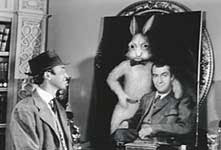
Adapted from the Pulitzer Prize-winning play by Mary Chase, Henry Koster directed this simple, light-hearted comedy starring James Stewart. Stewart plays alcoholic Elwood P. Dowd, an eccentric, polite gentleman who lives with his sister Veta (Josephine Hull), niece Myrtle-May (Victoria Horne), and Harvey. Harvey, Elwood’s best friend, is a six-foot three white rabbit visible only to Elwood, much to the alarm and confusion of the people around him. As his nervous socialite sister tries to have him committed to a mental institution, chaos ensues as his disarming demeanour allows him to unwittingly evade capture time after time.

This movie was one of my grandfather’s favourite films, and while I was brought up on a diet of classic westerns, war-films and lots of noirs from the forties and fifties, Harvey was always my favourite. It is endearingly innocent in the most hilarious way, with the ever-pleasant Dowd ambling along in a carefree daze, while the ‘sane’ protagonists fall apart around him. Returning to the film later in life, I found it had not lost any of its charm, but instead inspired thoughts about the treatment of people deemed mentally ‘unwell’, and how society considers ‘insanity’.

James Stewart’s Elwood remains one of my all time favourite movie characters. His unfaltering good nature and innocence are rare things in a hero, and when played with such genuine charm by one of Hollywood’s greatest actors, it is a wonder that this movie remains so criminally underrated.

Donnie Darko
USA 2001
Director: Richard Kelly
Screenwriter: Richard Kelly
Runtime: 113 min
Certificate: 15
DVD Distributor: 20th Century Fox Home Entertainment

From one invisible rabbit to another, this one a little more sinister than Harvey. Richard Kelly’s debut feature is a masterpiece of cryptic storytelling and somewhat of a philosophical conundrum. Donnie (Jake Gyllenhaal) is an exceptionally intelligent teenage boy with ‘emotional problems’, who sleepwalks, hallucinates and is quite possibly schizophrenic. After a hallucination where Frank the giant rabbit saves him from dying in a bizarre accident, he informs Donnie that the world will end within a month and coerces him into committing a series of apparently random crimes.

The beauty of Donnie Darko, aside from the acting, the cinematography, the soundtrack, the darkly engaging script and the esoteric comedy, is the lasting effect it has on you. No matter how many times one watches it, there are still innumerable unanswered questions by the conclusion. Any explanations held up soon crumble under the weight of the paradoxical, impenetrable plot. Even the most intelligent sounding philosophical clarifications can be invalidated due to the sheer number of contradictions within the film. Watching it under the influence merely leads to the delusion that you understand, only to later discover that you were just not thinking it through. One reviewer described it as possessing ‘infinite meanings’, but surely anything with infinite meanings is simultaneously rendered meaningless? See, even talking about it leads to nonsensical ramblings.

Whatever the intentions of Richard Kelly, Donnie Darko is a spellbinding film, which captivated my entire psyche for much longer then the two hours it lasts. Inspiring all manner of absurd conversations between my friends and me, it is still as much of a mystery now as it was when I first saw it. Either a work of unfathomable intellect, or a brilliantly conceived philosophical joke, it is still an undeniably beautiful and ingenious movie.

Read the final Part 5 tomorrow!

Craig Milne reviews his ten favourite films, Part 3

Withnail & I
UK 1987
Director: Bruce Robinson
Screenwriter: Bruce Robinson
Runtime: 107 min
Certificate: 15
DVD Distributor: Paramount Home Entertainment

A clichéd student flick, and possibly the most over-quoted film of all times, but there is no way I could dismiss Withnail & I purely on this basis. Bruce Robinson’s semi-autobiographical comedy about two unemployed actors and their rampant alcoholism is just too quirky, loveable and too damn funny for me to ignore.

The two misanthropes of the title decide they must escape the squalor of their flat in Camden, and take a journey to Penrith, to a cottage owned by Withnail’s Uncle Monty (Richard Griffiths). A meandering plot with no discernable direction, it is the strength of the dialogue which carries the film through the mishaps and disasters which befall the two title characters. That is not to say it should be regarded as a collection of quotable one-liners though. A superb supporting cast of eccentrics makes the lack of actual storyline immaterial, as the film becomes a hilarious freakshow of random encounters. Monty, a ‘raving homosexual’, bemuses with talk of ‘firm young carrots’ while leering at the terrified ‘I’. Danny (Ralph Brown), the affable yet strangely intimidating drug dealer, is such a great character he was even resurrected in Wayne’s World 2.


The title roles, filled by Richard E. Grant as ‘Withnail’ and Paul McGann as ‘I’, are so exceptionally well played that the dialogue feels natural and instinctive throughout. Grant and McGann bring the characters to life, although it is ironic that the pair should excel at playing two failed actors. But this is part of the film's innate charm. The overly dramatic Withnail avoids becoming a caricature of an arrogant drunk buffoon through the engaging performance by the effortlessly flamboyant Grant. McGann ties the whole shambolic proceeding together with an innocent, but far from naïve, humanity in the role of ‘I’.

Like all the films on my top ten, the best thing about Withnail & I is the enduring quality it possesses. After countless views, it still makes me laugh, grimace and even a little teary eyed.

Fight Club
USA/Germany 1999
Director: David Fincher
Screenwriter: Jim Uhls
Runtime: 139 min
Certificate: 18
DVD Distributor: Twentieth Century Fox Home Entertainment

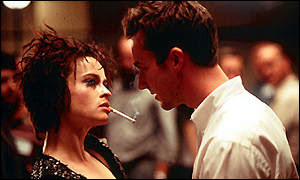
Arguably the cultural zeitgeist for the disenfranchised young white male at the turn of the century, Chuck Palahniuk’s novel, Fight Club, explores the dangers of the emasculating, consumer driven, capitalist society which is dominating our lives. A sinister tale of mental imbalance, nihilistic destruction and primal anger, the bleak dystopian novel was a perfect candidate for adaptation into an era defining movie. Whether or not David Fincher’s movie changed anything depends on your point of view, but for me it defined a large part of my youth and my life since. I first saw it when I was fifteen, and was profoundly affected by it. It made me question my position in society as a young, white, middle-class male, and it forever deterred me from entering the hideous banality of the corporate, white-collar world.

Again, the powerful performances of the lead actors, Brad Pitt as ‘Tyler Durden’, Edward Norton as ‘The Narrator’ and Helena Bonham-Carter as ‘Marla’, are major reasons why this is a great movie, as is the director’s flair for dark, subversive cinema (The Game, Se7en). The sharpness of the dialogue, the pitch-blackness of the comedy and the vicious, bloody violence are likely the main reasons why this is such a popular film, and to be fair, some of the reasons I like it. But there is much more to it than these superficial aspects. Fight Club captures the atmosphere of despondency which permeates so many aspects of our society, describing modern young males as a generation of men without history, without a purpose. An inwardly rebellious howl of masculine identity, it resentfully states that if society no longer needs men, then men no longer need society. Often overtly homoerotic and masochistic, it confronts the alleged ‘crisis of masculinity’ in post-modern society in what many critics and government officials described as a dangerously provocative way.

Delightfully sardonic, vitriolic and nihilistic, the movie stays true to the novel, but with Fincher’s distinctive cinematic style, Fight Club is one of the most unique cinematic experiences I have ever witnessed, and proof that movies can change your life.

Read Part 4 tomorrow!

Tuesday, 5 June 2007

Craig Milne reviews his ten favourite films, Part 2

The Big Lebowski
USA/UK 1998
Director: Joel Coen
Screenwriters: Ethan and Joel Coen
Runtime: 117 mns
Certificate: 18
DVD Distributor: Universal Studio Home Entertainment

Choosing this film was excruciatingly difficult as any number of the Coen brothers’ films could have been on this list. Including Fargo, O Brother Where Art Thou, Barton Fink and The Big Lebowski would have made for a very limited list indeed, so The Big Lebowski gets in purely because it makes me smile from ear to ear whenever I see it. Fargo is grittier, more exciting, and almost as funny, so it receives a very honourable mention, but the idiosyncrasies of The Big Lebowski and its eccentric charm make it impossible to leave out.

The noir influences of the movie shine through in every scene, but replacing the sharp suited, tough Humphrey Bogart character with a sandal wearing, burnout hippie skews the angle of the film into delightfully farcical territory. One of cinema’s most endearing and enduring cult icons, Jeffrey ‘The Dude’ Lebowski (Jeff Bridges), becomes embroiled in the schemes of his millionaire namesake as he seeks compensation for a soiled rug. The ensuing tale of kidnap, car theft, pornography, treachery, bowling and nihilism verges on the nonsensical. By the climax of the movie, one cannot help but wonder, as the Dude surely does, ‘what would have happened if he’d just cleaned the piss of his carpet?’

The movie is a surreal comedy of errors with a vague plot and incomprehensible characters rushing by as the Dude tries in vain to keep up. His jaw flaps at every idiotic twist, while his well meaning but unbalanced friend Walter (John Goodman) infuriates him to the point of insanity. Like a massive rambling train of thought that loses its point every ten minutes, The Big

Lebowski’s laugh a minute quote marathon seems to go nowhere, yet it arrives at a beautifully humbling, poignant conclusion. Fargo has the brains in the Coen brothers’ collection, but The Big Lebowski has so much warmth and heart, it wins hands down every time.

Fear And Loathing In Las Vegas
USA 1998
Director: Terry Gilliam
Screenwriters: Terry Gilliam, Tony Grisoni, Tod Davies and Alex Cox
Runtime: 118 mns
Certificate: 18
DVD Distributor: The Criterion Collection

There are literally thousands of reasons why Twelve Monkeys, Brazil or Monty Python and the Holy Grail should be Terry Gilliam’s entry on this list. But it would be terribly dishonest of me not to include Fear and Loathing in Las Vegas. It makes me laugh so hard I cannot breathe. The warped tale of Hunter S. Thompson’s savage trip to Las Vegas (first told in his book of the same name), with his borderline psychotic attorney, sets off at amphetamine fuelled pace and relentlessly burns a path through wrecked hotel rooms, hallucinatory casinos, bars, diners, motorcycle races and Debbie Reynolds concerts. Trying to find ‘the American Dream’, Thompson (Johnny Depp), under the alias Raoul Duke, and his attorney Dr. Gonzo (Benicio Del Toro), take excess to new levels, consuming more drugs than should be humanly possible, and creating total mayhem wherever they go.

Not that the film in any way glorifies excessive drug use. Its brutal portrayal of the ill effects of narcotics in several scenes shows a dark side to drug use that is quite often truly frightening. Scenes where Gonzo makes wild and incoherent accusations of Duke while waving a razor sharp hunting knife in his eye may be amusing, but there is always the suggestion that things could go badly wrong. The signs of violent crimes being committed are everywhere, although never actually seen: it would betray the original text to show them being committed. But there is acknowledgement that things are not as they seem, and that no one is in control.

Thompson’s distinctive, cryptic, vitriolic writing captures an atmosphere of wanton defiance and disobedience in the uncertain times of the early seventies. It is so rare to find a decent movie adaptation of a book, but to find one that takes the unhinged genius of the book and creates a film of equal merit is rare. The brilliantly psychedelic imagery, the hallucinatory effects, the non-stop barrage of visual distortions and the incomprehensible dialogue all capture the madness of Thompson’s unique literary style. Coupled with the inspired casting of Johnny Depp as the enigmatic writer and Benicio Del Toro as his corpulent accomplice, the chemistry of the movie is perfectly balanced between the sublime and the ridiculous. The legend of Hunter S. Thompson is brought to life with intensity, ferocity and dark, twisted mirth by Gilliam and his stars, and for all its stomach churning moments it is one of the funniest movies ever made.

Read Part 3 tomorrow!

Monday, 4 June 2007

Craig Milne reviews his ten favourite films, Part 1

Apocalypse Now
USA 1979
Director: Francis Ford Coppola
Screenwriters: John Milius, Francis Ford Coppola
Runtime: 153 mns
Certificate: 18
DVD Distributor: Paramount Pictures

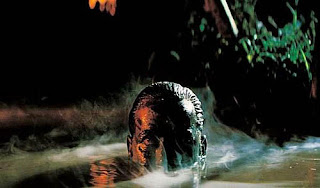
Francis Ford Coppola’s absurdist epic treatment of the Vietnam War has to be the first film on my top ten. It has an enormous personal significance for me as it inspired me to write my undergraduate thesis on the role of Hollywood in culturally, socially and historically defining the Vietnam War. Having watched it countless times, it never loses its impact. The sheer power of the imagery, the horrific realism of the cinematography and the ingenious performances ensure Coppola’s masterpiece (yeah, that’s right, bollocks to The Godfather) outshines any other movie I’ve seen.

Dispensing with the simplistic, black vs. white combat genre, Coppola took Joseph Conrad’s novel The Heart of Darkness as the basis for his plot and incorporated elements of Chandleresque noir detective and classic journey/quest narratives into a warped, frenzied vision of a war fought without restraint, without order. From the opening scenes of napalm enveloping the jungle, to the closing psychedelic madness, it is a phantasmagorical journey through the heart of a nation’s darkest military endeavour.


The harrowing experience of actually making the movie makes it even more worthy of praise and respect. The personal cost to Coppola stretched into the millions of dollars after the project became dangerously over-budget, he had several nervous breakdowns and threatened suicide numerous times when on location. Martin Sheen (Captain Benjamin L. Willard) suffered a near fatal heart attack after shooting, originally intended to last six weeks, continued for sixteen months. In several scenes, Sheen was completely inebriated, and many of the cast, especially Sam Bottoms (Corporal Lance Johnson), were under the influence of marijuana, LSD and speed. In the final weeks of shooting, Marlon Brando (Colonel Walter E. Kurtz) arrived on location massively overweight, without having read the script, or Conrad’s novel, and stubbornly refused to work with the existing screenplay. In many ways Apocalypse Now truly captures the insanity and brutality of the Vietnam War because of the insanity and brutality of its creation. Quite simply, no other film comes close to matching the perfect balance of beauty, repulsiveness, realism, surrealism, politics and irony that exists in Coppola’s masterpiece.

The Usual Suspects
USA/Germany 1995
Director: Bryan Singer
Screenwriter: Christopher McQuarrie
Runtime: 106 mns
Certificate: 18
DVD Distributor: PolyGram Home Video

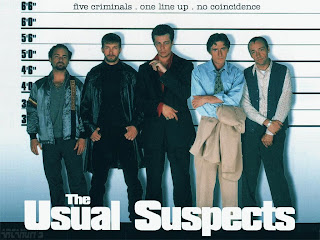
Bryan Singer’s The Usual Suspects comes in strangely high in my list, considering that at first I could find no other reason to include it than the finale. But what an ending! Words cannot come close to describing the ingenuity of the final reveal in this sinister crime thriller.

Almost a supernatural ghost story, the tale told by Roger ‘Verbal’ Kint (Kevin Spacey) of a mismatched group of crooks united by a mysterious criminal overlord sucks you in with its constant twists and turns. By the time you sit back and think ‘I get it’ (don’t try to deny it, you thought you had it all figured out), the hard fast bitch-slap of a twist hits you square in the jaw, leaving you awestruck, bemused and overwhelmingly impressed.

The most suspense-filled, thrilling film I have ever seen, the impact of the movie is not lost on repeated viewing; it still sends shivers up my spine every time. The final scene is, for me, the all time greatest movie scene ever, I always grin and shake like an excitable child when it is all over. The soundtrack, stark and jarringly composed by John Ottman, is arguably the best soundtrack ever if you take Bernard Hermann out the picture. Kevin Spacey puts in the performance of his career as the nervous but canny fraudster, Kint, and the supporting cast, with the exception of Stephen Baldwin, are all outstanding. Basically, this film is the reason why I love cinema, it’s dark, dirty, implausible and superficial, but it is never anything but truly and utterly gripping.

Read Part 2 tomorrow!

Friday, 1 June 2007

James Martin reviews his ten favourite films, Part 5

The Secret Garden
USA/ UK 1993
Director: Agnieszka Holland
Screenwriter: Caroline Thompson
Runtime: 101 mns
Certificate: PG
DVD Distributor: Warner Home Video


Agnieszka Holland came up with a visually captivating film version of Frances Hodgson Burnett's classic story. At the end of the nineteenth century, after the death of her parents in colonial India, spoilt but unloved ten year-old Mary Lennox (Kate Maberly) is sent to her uncle's (John Lynch) gothic Yorkshire manor, under the watchful eye of strict housekeeper, Maggie Smith. Wandering through its labyrinthine halls, she encounters her bedridden cousin, Colin (Heydon Prowse) and discovers a hidden walled garden, locked after her aunt died there.

Holland took the liberty of changing one detail. Mr and Mrs Lennox originally passed away in a cholera epidemic, not in a violent earthquake, as portrayed. However, the aesthetics of this film do splendid justice to the novel. In the opening credits, still, murky shots of the Rajasthan desert at dusk beautifully conjure up a "hot, strange, mysterious land", with the palatial, ivory domed house emerging majestically from a crimson haze. The earthquake scene, depicting her mother's garden party, with a decadent visit from the maharajah on an elephant is subsequently both gripping and poignant. Such an idyllic, but arid paradise is brought crashing to the ground without warning.

Later, lingering tracking shots across the Yorkshire countryside, a well re-told story and superb performances, particularly from Kate Maberly in her first outing, ensure that the pacing is never too slow. Agnieszka Holland paints with breathtaking strokes what no other version, even the much-acclaimed 1949 film starring Margaret O'Brien, has on its canvas. Sinister Mistlethwaite Manor, as illustrated in the novel, appears in the film as a depressingly dark but stunning castle à la Bram Stoker, complete with tapestry-clad walls and mysterious hidden passages meandering through long forgotten, neglected rooms shrouded in decades of secrets. Haunting medieval harpsichord tones enhance a sense of listless nostalgia and sadness, which this lonely little girl was never before capable of feeling.

Undoubtedly the most handsome remake of the classic children's story, this wonderfully moving production captures the very essence of grief, longing and painful memories. Holland has transformed it into a superb film, aimed as much at adults as at younger viewers.


Oliver Twist
UK/ Czech Republic/ France/ Italy 2005
Director: Roman Polanski
Screenwriter: Ronald Harwood
Runtime: 130 mns
Certificate: PG
DVD Distributor: Sony Pictures/ TriStar

The most recent remake of Dickens' novel is a delight to behold, despite one blatant flaw. To me, it seems somewhat arrogant of Roman Polanski to mutilate one of the greatest works of English literature, by omitting its most pivotal unfolding event. The destitute young girl, who died in childbirth in the workhouse was in fact Mr Brownlow's (Edward Hardwicke) daughter, which makes Oliver his grandson. It is, after all, the most vital discovery in Dickens' plot, with several clues leading up to it, here simply trifled out.

That said, the acting and the cinematography combine to make Polanski's production visually satisfying. Filmed along the traditional cobbled streets of old Prague, the skilled camerawork catches something strikingly reminiscent of Victorian London.

Unlike Oliver!, Polanski's version succeeds in reproducing the harsh realities of life as a pauper and an orphan, without playing anything down. Dickens' gift for paying intimate attention to detail is captured with great skill by Polanski, from the incriminating book still clasped in Brownlow's hand at the magistrate's court, to the small intricacies of a handshake and the "outside chill" which Nancy (Leanne Rowe) feels "right through her".

Oliver Twist is by no means perfect, but it is as near to a rendering of Dickens' writing style as could be possible on screen. Other versions by David Lean (1948) and the 1982 production, starring George C. Scott as Fagin, cannot aesthetically hold a candle to Polanski's latest vehicle.

This concludes James Martin's Top Ten!
Thank you for reading!

Wednesday, 30 May 2007

James Martin reviews his ten favourite films, Part 4

Swimming Pool
France 2003
Director: François Ozon
Screenwriter: François Ozon
Runtime: 102 mns
Certificate: 15
DVD distributor: 20th Century Fox Home Entertainment
(contains plot spoilers)

Acclaimed director François Ozon's thriller is a haunting, surreal tale of passion and intrigue, set amidst the sun-drenched vineyards of south central Provence. Charlotte Rampling is Sarah, an uptight, constipated English writer who goes to stay at her publisher's (Charles Dance) holiday home, in search of inspiration. It all seems a paradise of tranquillity, until Dance's promiscuous, fun-loving nineteen year-old daughter, Julie (Ludivine Sagnier) unexpectedly arrives. Before long, she upsets Rampling's old-fashioned values with her topless swimming, sunbathing and abuse of the house as a nightly, drug-fuelled disco-brothel. Just as the pair come to a mutual understanding, the hysterical girl viciously murders one of her partners in the heat of the moment….

The cinematography, with its slow, still shots of the sleepy summer countryside only enhance a feeling of eerie mystery, which works well with the equally dream-like, but utterly ambiguous ending. Touches of humour abound in the stereotypical contrast between Rampling's dour English haughtiness and Sagnier's French Lolita. However, the film's greatest asset is its gripping suspense, brought about by long moments of tense, rigid silence, dramatic facial expressions and the expanse of emptiness surrounding the whitewashed villa.

The unexpected bond formed between the two women is an integral part of the mystery and Charles Dance's brief role is in fact far more pivotal to the story line than it first appears. Swimming Pool is a fascinating portrayal of how unsettling past events and secrets can suddenly rear their ugly heads with cataclysmic effects.


Oliver!
UK 1968
Director: Carol Reed
Screewriter: Vernon Harris
Runtime: 153 mns
Certificate: PG
DVD distributor: Columbia TriStar

Carol Reed's deliberate saccharine portrayal of 1830s London, not to mention an unabashed sweetening of Dickens’ novel with several ounces of Tate and Lyle can be excused, for Oliver! is a fantastic musical with memorable songs and a first-class cast. Mark Lester makes a timid and highly credible young Oliver, Ron Moody is humorous as hard up skinflint Fagin, Oliver Reed plays a brutal Bill Sykes, but Shani Wallis steals the show as poor, kind-hearted, frustrated Nancy.

This version also deserves a mention as the first to re-tell the story in a non-monochrome format and in particular scenes, such as when Nancy is bludgeoned by Sykes, the exaggerated use of Technicolor is beautifully poignant, as her dress appears strikingly crimson. It would be so easy to ruin Charles Dickens with too much syrup and a lively score, but Carol Reed ensures that only so much edge is removed and that hardship and poverty are never far away.

Shani Wallis gives the best and most spirited performance by far, as she claims "civil words, civil words- God help me, you've had me out there on the streets since I was 'alf 'is age!" The film's most unforgettable scene is when Nancy snatches Oliver from the tavern, having engaged the other drinkers in a flurry of "Oom Pa Pa" to distract Moody and Reed. It is such a moving contrast with the subsequent outcome for her.

In order to create a family classic from the story of Oliver Twist, it is perhaps necessary to play down the sombreness and present particular aspects through a rose-tinted lens. With all of the essential ingredients, Reed has folded the mixture to just the right consistency.

Read the final Part 5 tomorrow!

James Martin reviews his ten favourite films, Part 3

Walkabout
UK 1971
Director: Nicholas Roeg
Screenwriter: Edward Bond
Runtime: 100 mns
Certificate: 12
DVD distributor: The Criterion Collection

(contains plot spoilers)

John Barry composed the wonderfully haunting background music for Nicolas Roeg's moving film about two anonymous English schoolchildren. A fourteen year old girl (Jenny Agutter) and her seven year old brother (Lucien John) live in suburban Sydney and become lost in the infinite wilderness of the Australian bush, after their suicidal father torches the car at a family picnic. In the book, they are called Mary and Peter, and are abandoned in the arid Northern Territory, the sole survivors of a plane crash. However in the film their identity is irrelevant, since they are far away from civilisation in most scenes.

Nicolas Roeg did his own cinematography, which is strikingly beautiful. The camera slowly pans out from rugged cliffs of quartz across the endless, burnished sand and salt plains. An oasis they discover bears lush vegetation and ripe red fruits under a deep azure sky, and offers a stark contrast with the suffocating heat of the open bush. The wonderful uniqueness of this cult classic is its strained and often unfathomable moments of silence, when all the viewer can do is sit back and soak up the breathtaking scenery.

In this coming of age drama, Lucien John's role is somewhat swept under the carpet, in favour of an erotic atmosphere, which crackles with sexual tension between Agutter and the young Aboriginal man on "walkabout" (David Gulpiplil). He kills himself after she apparently spurns his advances and we are shown endless, sinister close ups of strange insects and dehydrated animals. There is a constant reminder of the harsh, unforgiving natural environment, in this unusual story of death and imperative human resilience.


Dangerous Liaisons (1988)
USA/UK 1988
Director: Stephen Frears
Screenwriter: Christopher Hampton
Runtime: 119 mns
Certificate: 15
DVD distributor: Warner Home Video

John Malkovich is a hoot as the Vicomte de Valmont, a vile, manipulative cad who will stop at nothing until he has seduced his latest sexual conquest, forever having the upper hand. Glenn Close is perfectly cast as the scheming Marquise de Merteuil, whose ruthless endeavour is to publicly scandalise the sex lives of younger women who have stolen her former lovers, and utterly humiliate them. She works in liaison with Valmont to destroy nubile virgin Cécile (Uma Thurman) and former convent girl and paragon of chastity Madame de Tourvel (Michelle Pfeiffer).

The camerawork sumptuously portrays eighteenth century France and the romps and peccadilloes of its landed gentry, as depicted in Choderlos de Laclos' scandalous 1782 novel. Director Stephen Frears has produced a drama, which is as visually pleasurable as it is amusing, shocking and deliciously cruel. Lavish, decadent Versailles-style boudoirs and séjours dominate the screen, while Close typically fans herself as Malkovich, her one time lover, sensually whispers flattering profanities in her ear.

The skilled direction ensures that the two protagonists interact and move in flawless timing, when shot together as in some sort of elaborate dance from the period. He lowers his powdered, wigged head as she rises, she reaches for his hand and he rolls his eyes at her catty remarks. The intricate flashbacks to their past relationships portray Valmont and Merteuil as infallible connoisseurs of sexual emotion and its exploitation and are startlingly contrasted with her final humiliating exposure and demise.

By today's standards, Dangerous Liaisons cannot shock nearly as much as the novel intended to and succeeded in doing at the time of print. Nevertheless, it is intriguing to see just how far Laclos was prepared to push the boundaries of so-called social acceptability and how exquisitely Frears has dramatised it.

Read Part 4 tomorrow!

Tuesday, 29 May 2007

James Martin reviews his ten favourite films, Part 2

The Wolves of Willoughby Chase
UK 1989
Director: Stuart Orme
Screenwriter: William M. Akers
Runtime: 93 mns
Certificate: PG
Not distributed on DVD

Stuart Orme's adaptation of Joan Aiken's children's novel is more amusing and camp than the book, which was a tearjerker. The drama is no less enjoyable, with a fine cast. Stephanie Beacham plays grasping governess Letitia Slighcarp, who along with port swigging sidekick Mel Smith, attempts to relieve holidaying Lord and Lady Willoughby of their fortune, in front of their helpless, spoilt eight-year old daughter Bonnie (Emily Hudson) and her quiet, well-mannered cousin, Sylvia (Aleks Darowska).

Filmed in winter, in the backdrop of dark, frigid woodland in former Czechoslovakia, this production is visually stunning and the cast has a whale of a time. Beacham, fresh out of Dynasty, flounces about in fussy Victorian dresses, making life a misery for the two girls, whilst teaching them nothing. She packs them off to a grim, industrial workhouse, where they languish under a hilarious drunken "Brisket" (Geraldine James), who casually misinforms them of the Willoughby's death in a sinking. Beacham's best line is "I'd like to see the wolf that could tackle me", which is ironically her gory end.

As a child, I loved this film for the suspense brought about by "the nasty adults and what they'd do next." Now, I appreciate it as a highly entertaining and sweet story, not intended to be hilarious, but which cannot help extracting laughs for its comically gifted cast and ridiculous, far-fetched situations. Understandably, The Wolves of Willoughby Chase received mixed reviews, as it would not be everyone's cup of tea. However, if your sense of humour is at times silly and puerile like mine, you will find that Aiken's book could not have been translated from page to screen with more flair.

Alice's Adventures in Wonderland
UK 1972
Director: William Sterling
Screenwriter: William Sterling
Runtime: 101 mns
Certificate: PG
DVD distributor: Reel Media International


Of all film productions of Lewis Carroll's novel, William Sterling's is by far the most faithful. This is a lively musical with an all-star cast, including Michael Crawford as the highly-strung, twittering white rabbit. Peter Sellers plays the March hare and Fiona Fullerton makes an impeccably spoken teenage Alice.

The opening scenes are breathtaking. Filmed on location on a verdant Oxfordshire riverbank in high summer, Charles Dodgson (Michael Jayston) begins his tale, sending drowsy Alice into her "curious" dream, an underground world with a pastel pink sky, insane creatures, accusatory playing cards and height-altering mushrooms. John Barry's dreamy score is most effective and complements the beginning, as inquisitive Alice wanders through the opening of a disproportionately large rabbit hole and begins floating down surreally "through the centre of the earth".

This version is so painstakingly true to the written text, where others by Walt Disney (1951) and Harry Harris (1985) are not. It successfully combines nonsensical dialogue with a definite sense of Alice's increasing self-awareness, through songs such as "The Me I Never Knew". Other versions seem to gloss over this part, concentrating solely on the absurd. Fullerton's constant analysis and self-questioning - "I wonder whether I shall land among the antipodes of Australia or New Zealand" or "why, I appear to be shutting up like a telescope"- emphasise the story's most important message. It is all about an adolescent girl's struggle to find meaning in a world which does not always make sense and where adults' actions are often illogical, therefore frustrating. For an avid childhood reader of Lewis Carroll, this film is excellent. It is the only one which convincingly manages to capture that strange dream world and its characters, both visually and audibly.

Read Part 3 tomorrow!

Monday, 28 May 2007

James Martin reviews his ten favourite films, Part 1

The Shining
USA 1980
Director: Stanley Kubrick
Screenwriters: Stanley Kubrick, Diane Johnson, Stephen King (novel)
Runtime: 119 mns

Certificate: 18
DVD distributor: Warner Home Video

The Shining is one of the most poignant horror films I have ever seen. In 1999, when I was going on sixteen, it unexpectedly scared the living daylights out of me. Some critics thought that Kubrick's portrayal of an insane writer attempting to slaughter his wife and son in a deserted, snow-bound hotel was over the top. Author Stephen King was appalled and felt that the director had made an incompetent hash of it. Critic Jacob Levich, despite having bestowed four stars upon it, wrote: "Nicholson's performance is too much. By the time of the climactic chase, he's lurching around like a cut-rate Quasimodo."

Harsh criticism did not detract from The Shining's success and it is easy to see why. Slow aerial opening tracking shots of Torrance's (Nicholson) car cruising through the wilderness of rural Colorado immediately emphasise how isolated he, his wife Wendy (Shelley Duvall) and son Danny (Danny Lloyd) will be. The doleful, ominous brass score gives a sense of impending doom, while the contortions of the little boy's face, whenever he has premonitions of drowning in blood or self-regresses to become sinister imaginary friend Tony, are eerily convincing.

Best of all is the never ending, suspense-laden shot along a corridor, with the camera closing in behind Danny on his tricycle. The rumbling background music, coupled with that nauseating impression of moving along the hypnotic, vertigo-inducing patterned carpet is enough to make the viewer travel sick, when the scene suddenly climaxes in a vision of the mutilated twins beckoning him.

Nicholson's demonically possessed character comes unsettlingly natural to him and his "I'm not gonna hurt you, I'm just gonna bash your fucking brains in" is creepy and effective. Picture yourself in his victim's shoes. This movie may have lost much of its chilling appeal by now, but of its genre it is undoubtedly the most memorable for me.

Mommie Dearest
USA 1981

Director: Frank Perry
Screenwriters: Frank Perry, Robert Getchell, Christina Crawford (autobiography)
Runtime: 129 mns
Certificate: 12A
DVD distributor: Paramount Pictures

To be engrossed by Joan Crawford (Faye Dunaway) screaming like a banshee and thrashing a wire coat hanger at her two innocent "darlings" must be something akin to sadism. Certain scenes are so cruel they are unbearable to watch, yet director Frank Perry never ceases to ensure that the attention of the viewer is forever consumed by morbid curiosity. Based on Christina Crawford's controversial autobiography, Mommie Dearest catalogues a childhood allegedly rife with emotional and physical abuse endured by Christina (Diana Scarwid) at the hands of her pernickety, obsessive and violently temperamental adoptive mother, in their lavish Hollywood mansion.

What makes this picture so intriguing is that Crawford genuinely appears to love both Christina and her brother Christopher, yet overreacts unimaginably and always vents her frustration on the girl, justifying it with a mere "I don't want her to make my mistakes." The story, if true, makes one wonder what psychological insecurity might cause somebody to treat a child so inhumanely. Dunaway, aptly done up for the most part like a monster in a face pack, epitomises how a lifetime in the cut-throat "shitty movie business", if taken too seriously, can make one embittered, insanely jealous and ruthlessly competitive.

Several years and events later, the ending is the cherry on the cake. Crawford is dead and "for reasons well known to them" leaves her foster children with nothing. Joan "has had the last word as usual". "Has she?" Christina retorts coldly to Christopher, as the camera focuses on the girl, dissolved in thought. This is a touching and disturbing film, which although excruciatingly one-sided, does every justice to an autobiography with a bone to pick. The delicious quirk is that Joan's apparent life-long insistence on "being unbeatable" will backfire with a vengeance, in the form of a poisonous memoir.

Read Part 2 tomorrow!

Tuesday, 10 April 2007

Princess - Review by James Martin

Director: Anders Morgenthaler
Screenwriter: Anders Morgenthaler and Mette Heeno
Runtime: 90 minutes
Certificate: N/A
Release date: N/A


Princess is particularly eye-catching because it is a dark, adult animé and certainly not for children. Unlike so many of the slow, saccharine Disney/Pixar outings repetitively churned out ad nauseum these days, it deserves special attention for its unique originality. Reminiscent of Japanese comic book films, for its violence, profane language and sexual references, Princess is mainly animation and about twenty percent live action. Real actors play the three protagonists, which makes the harshness of it hit home all the harder, without the safety net of "oh, it's just a cartoon", to play it down.

August (Christian Tafdrup) is a missionary priest, who comes home to look after Mia (Stine Fischer Christensen) his five-year old niece, after his sister Kristine (Thure Lindhart), an ill-treated call girl, dies from a drug overdose. August's grief turns to anger and he becomes hell-bent on avenging those who dragged his sister into the world of smut. The sole criticism is that at times, the storyline is implausible. A shy, reticent priest can hardly be capable of fending off six macho members of the Danish porn mafia in a restaurant, successfully killing all of them with a handgun. Furthermore, if he is so intent on protecting his adorable little niece, he is unlikely to take her with him in his pursuit of the elusive Charlie, his sister's abusive ex-lover.

Unrealistic scenes in which Mia's stuffed rabbit, Multe comes to life, winking and prancing all over the show, symbolise that despite everything, she is still just an innocent child. Evidence of the emotional trauma this poor child has suffered is her shocking insistence that the other kids in the neighbourhood refer to her as "the whore". Princess is a daring and unusual attempt to reveal how unbalanced a naïve child can be rendered through abuse. Not for the faint hearted.

Friday, 2 February 2007

Babel - Review by Craig J. Milne

Director: Alejandro González Iňárritu
Screenwriter: Guillermo Arriaga
Running Time: 142 mins
Certificate: 15
Released: Now

Guillermo Arriaga must be a genuinely disturbed fellow. The scriptwriter of Alejandro González Iňárritu’s ‘trilogy’, Amores Perros (2000), 21 Grams (2006) and now Babel, has consistently been fixated with humanity in the face of tragedy and suffering, connecting a number of intertwined stories through the catastrophes he creates. Babel has taken his obsession to new, soul-crushing, bleak depths.

The compulsory A-list stars, Cate Blanchett and Brad Pitt, are holidaying in Morocco when Susan (Blanchett) is fatefully hit in the neck by the wayward gunshots of Yussef (Boubker Ait El Caid
) and Ahmed (Said Tarchani), two young boys protecting their father’s goat herd. Simultaneously, their children are taken illegally into Mexico for a wedding by their well-meaning, if astoundingly stupid nanny Amelia (Adriana Barraza). In one of the most tenuous links in movie history, the daughter of the former owner of Yussef and Ahmed’s rifle, a deaf Japanese teenage girl (Rinko Kikuchi), struggles to cope with the suicide of her mother and the loneliness of her own existence.

As the four divergent stories unfold, the tragedy and sorrow becomes palpable, verging on the impenetrable. The two young Moroccans try in vain to evade police capture for the shootings, Blanchett faces the possibility of bleeding to death in a remote mountain town, the nanny and her Aryan poster child charges become hopelessly lost in the desert around the border and the Japanese girl takes her clothes off a lot.

Thematically Babel is powerful, examining cross-cultural differences through its trans-nationally entwined tales, touching on American foreign policy and media coverage, Moroccan police brutality, the sense of community in Mexico and the difficulties of growing deaf. The acting, although dominated by the big names, Blanchett, Pitt and rising star Gael Garcia Bernal, includes exceptional and touching performances from the two young North African’s El Caid and Tarchani who are the true stars in this picture. Pitt, looking haggard and about as old as he actually is, gives a notable performance as Richard, the panic stricken husband of Blanchett, while she collects what must have been the easiest pay-cheque of her career for lying down throughout the duration of the film.

Iňárritu and his collaborator Director of Photography, Rodrigo Prieto (Brokeback Mountain, Alexander) provide obligatory, exquisite cinematography which will have some critics raving about ‘masterpieces’, however it does not excuse the fact that Babel is overblown, portentous and in places interminably depressing, outrageously implausible and jaw-droppingly cruel. Iňárritu is a sadistic puppet master, inflicting endless pain and anguish upon his characters, and no amount of artful composition can compensate for such ceaseless heartbreak.

Please feel free to post comments...

Running with Scissors - Review by James Martin

Director: Ryan Murphy
Screenwriter: Ryan Murphy
Running Time: 116 mins
Certificate: 15
Released: now

Running with scissors, set in 1979, is black comedy at its darkest. Director Ryan Murphy strikes just the right balance in the film, which is both hilarious and touching. This movie is preoccupied with the idea that life can leave you with deep emotional scars, as painful as those acquired from performing the titular act. Augusten Burroughs (Joseph Cross) is sent to live with eccentric 'shrink' Dr Finch (Brian Cox) and his family, while his highly strung, arty-farty mother, Dierdre (Annette Bening) undergoes treatment from this doctor for depression. Meet the family; batty Mrs Finch (Jill Clayburgh) snacks on dried pet food and the 'favourite' daughter, Hope (Gwyneth Paltrow) considers herself telepathic, 'conversing mentally' with her cat, Freud. Hippy-chick, Natalie (Evan Rachel Wood), the 'other' daughter is rejected by Augusten, as he 'comes out' and starts dating 35 year old Neil (Joseph Fiennes); another of Dr Finch's mentally unstable patients. Meanwhile, Augusten's mother Dierdre goes through a succession of lesbian lovers, while sliding ever further down the slope of instability.


Bening as Dierdre Burroughs is one of the film's greatest assets. This type of character is her forte. The acting is reminiscent of her previous roles, Catherine de Merteuil in Valmont (1989) and the screeching harpy, Carolyn Burnham in American Beauty (1999) and she leaves her syrupy, sweet performance in The American President (1995) in the shade. Dierdre is tempestuous and does a highly convincing nervous breakdown, chewing candle wax at Augusten's 15th birthday party, while mumbling "this is good!" Amusing as this scene may be, Augusten's character invokes pity, as the camera closes in on him to show a stream of tears flooding down his heartbroken face. The musical score couldn't be more seventies if it tried, and never leaves the viewer in any doubt about how to feel. When the mood is upbeat, there is jazzy piano music and at more intimate or tear-jerking moments, love songs by stars like Johnny Mathis are played. However, music is never used as the easy way out of portraying genuine emotion, which sweats out of every character in bucket loads.


Equally well done are wacky performances from Dr Finch's family. Long suffering Mrs Finch serves fish sticks and grapes for dinner, as she exclaims; "I am not a maid!" Brian Cox is excellent as the calm, collected but crackpot doctor, who never looses his cool, even in the face of unnecessary destruction. Augusten and Natalie wanted to 'heighten the ceiling' and earnestly, he replies "I think it brings a much-needed sense of humour to the kitchen." However, the crazy touches of humour never spin out of control, rather they are kept in check throughout by an overwhelming sense of sadness. This comes partly from Augusten and his goateed, schizophrenic lover (Fiennes), neither of whom feel able to 'fit in' in society.


All in all, this is an impeccably directed film, which never goes too far and is a pleasure to watch, for all its touching moments and instances of sheer, unbridled hilarity. However, Running with Scissors is like marmite in that it might not be everyone's cup of tea. Some might really enjoy this unusual cinematic experience, whereas others might be put-off by its quirkiness or find it verges 'too close to home.' In any case, the film, based on Augusten Burroughs' 2002 autobiography has a powerful message. Running with scissors can leave deep, painful scars, but just as you would learn from this experience, never to run with scissors again, metaphorically you can learn not to repeat similar, emotional experiences in life and learn from your mistakes.
Please feel free to post comments...